Learnings from Mashpi pt. 2
With pleasant themes of the good parts of being human (no mentions of chicken murder)

I won’t forget the day Agustina told me she was heading to town to play fútbol and asked if I wanted to come. I was hesitant.
For context, I wasn’t allowed to play soccer as a kid and thus never developed the level of foot-eye coordination needed to feel successful in the sport. When I failed to make the Seattle United soccer team in middle school, I decided soccer just wasn’t my thing and retired my cleats for good, hoping I’d spare myself from further embarrassment. Sad, right?
So when Agu offered to sign me up for a game in a country where kids can juggle a soccer ball before they can walk, I didn’t jump on the opportunity with enthusiasm. I wasn’t necessarily excited to re-live my childhood shortcomings. I had a lot of questions: Would it be competitive? Would I be welcome? Also, the only shoes I have are my work boots! She told me it’d be a “fun time,” so I reluctantly climbed on my bike and followed her down the muddy road.
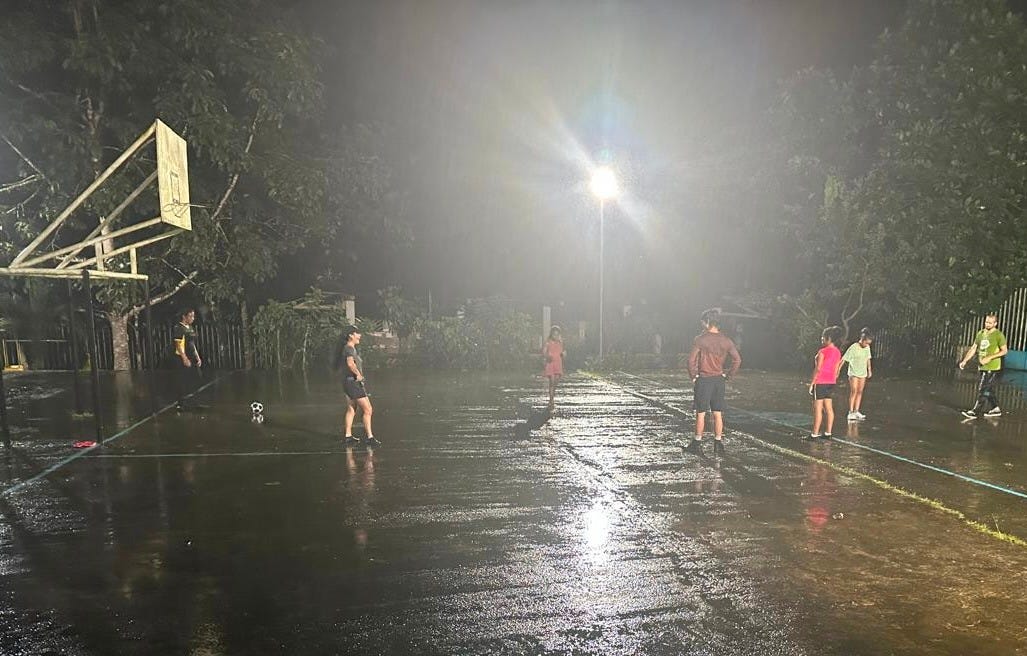
The “field” wasn’t what I expected: a cracked cement court behind the school, two netless goals at either end, plenty of puddles for obstacles. As I began to stretch and mentally prepare for an intense match, a horde of screaming, sandal-wearing children charged in, ready to play. A couple more adults trickled in — Karina and Jessica from the chocolate factory — but it was clear the kids ran this show. Phew. Maybe this won’t be so humiliating.
Right off the bat, it turned out to be some of the most fun I’ve ever had. Chaos, laughter, slipping, shrieking, smack-talking, and playful taunting — these kids knew how to have a good time. One eight-year-old kept trying to slide-tackle and missed every time, sending himself flying and everyone into hysterics. We played well into the dark, soaked and breathless, finally calling it when dinner time had long passed. When my team won, it was jumping high-fives all around. The sweetness of victory took the form of ice-cream cones — homemade in the house next door — and we savored them in the humid rain, covered in mud and our cheeks sore from laughing.
After biking home on a bumpy route lit only by moonlight and fireflies, I couldn’t stop thinking about how much fun I just had and thought “why don’t I ever do that at home?” Yes, part of it was my personal resistance to the sport, but here, the game wasn’t about winning, like it always seemed to be in my childhood. It was just pure fun, with good company, fresh air, and exercise woven in too.
My serious, American brain wanted to label the game as something “productive” to justify its value: decent cardio, nice way to be social, time spent outside. But I can guarantee that none of those kids were there because their mom forced them to “go outside” or “make friends.” At the core of it, we were all there for the same reason: just some good old-fashioned joy.
It’s strange, I feel like I’ve forgotten the value of joy — like real, unrestrained, child-like joy. In the culture I grew up in, everything is taken so seriously that even youth sports are more competitive than joyful. And now as an adult, I feel like I’ve subconsciously replaced child-like joy for the serious, “civilized” form of grown-up entertainment: the nights of pleasant conversation and maybe a couple drinks; the evenings that end with a pretendingly mature “ah yes, that was nice, let’s do that again sometime!”
If being an adult in America means leaving real joy behind, I don’t want to grow up. I’d much rather be fending off 50-pound demons in an exhilarating game of soccer than restraining how much joy I get to feel for the sake of being a “grown-up.” Call it immature, but I think there’s value in playing like a kid — moving your body as fast as it can go, laughing till it hurts, and feeling completely alive. Life should be fun!
A couple days later, Karina, the 36-year-old single mother who works at Mashpi Shungo, invited me to her house for lunch. I was starting to get the impression that she might have had some romantic motives… but I accepted the offer for the cultural experience.
Karina’s house sits atop a beautiful hill overlooking “downtown” Mashpi and was relatively large — at least large enough for her two parents, three kids, and a couple other relatives. When I arrived, Karina told me lunch wasn’t ready yet and we needed to find her sister before we could eat. We walked through some forest to her sister’s place and it was a fun surprise to find out her sister owns a mariposario — a butterfly house. She raises hundreds of butterflies and apparently sells them (to whom I have no clue). But thank god I’ve outgrown my childhood fear of butterflies because they were overly comfortable with humans and thought my head made a nice landing pad. I even got to hold one twitching in its cocoon, trying to break free. Pretty wild.
Lunch was rice, plantains, salad, and fried hunks of pork, with dozens of people moving in and out of the house like it was an open dining hall. Grandparents, little kids, aunts, uncles, husband-in-laws, and even some random neighbor all came for a bite. We ate with our hands (and spoons when necessary) because, as Karina’s dad put it, forks and knives were unnecessary and would have just meant more dishes. I liked that.
After lunch, we played cards and made small talk about our very different lives. People always ask how many siblings I have, and when I answer “just one,” they look at me with sympathy as if I had basically just said “none” (don’t worry Logan, you’re enough). For me, “family” has always been nuclear — 4 or 5 people per household — but here, families are enormous. It’s not uncommon to meet people with more than ten children — so far, SIXTEEN is the most I’ve heard. At such a size, families also seem to be the foundation of community here, and on several occasions now, people have been proud to tell me it’s the most important thing in their life.
I recently realized that all the best moments of my life seem to share this common thread: a strong sense of community, love, and belonging. It sounds cheesy, but it’s true — all my happiest days have included people I care a lot about.
This isn’t a revolutionary thought, in fact, maybe that’s why it sounds so cliché. Research has even shown that the quality of our relationships is the most important factor in predicting our quality of life, health, and even lifespan. Why don’t we take that seriously?
Back home, I’ve gotten used to eating meals alone and scheduling hangouts with friends like dentist appointments. Everyone’s so busy with work and their individual little lives that it feels like human connection gets pushed aside — we’ve been moving away from meaningful friendships and towards a shallow “catch-up culture.” I think I’m romanticizing life in Mashpi because community is embedded directly into daily life and it seems impossible to feel lonely here. I took social life for granted in college, but now that my friends are spread out around the country (and globe) and working their real-world jobs, I’m realizing how important community is in living a good life — and how difficult life can feel without it. To all my friends and family reading this: I love and miss you guys!
It appears that community goes hand-in-hand with another factor to good living: safety.
After coming from Quito, where people wear backpacks on their fronts and protect their phones like newborns, Mashpi felt like heaven. In a town too small to have a police station, crime is virtually non-existent. And with only about 150 people in town, you can’t really steal from someone without having to see them the next day.
You can leave your bike unlocked or even your phone out of sight. Nobody’s taking it. The greatest danger around here is getting kicked by a horse — or your shin busted by an eight-year-old in a game of fútbol. I mean, most of the houses in Mashpi are open-air and don’t even have lockable doors! I’m assured the people here are very tranquilo.
It reminded me of Bhutan, another place where people just… trusted each other. There, a friend once left a suitcase outside the airport for hours, completely untouched. Someone else forgot their wallet in a taxi, and got it hand-delivered back the next morning. I remember the first time I saw a woman ask a complete stranger in a crowd of people to hold her baby and it just about blew my mind. Try imagining that in America. Yeah right.
I think I’ve become so used to covering valuables in parked cars and averting eye contact on public transportation that I wasn’t fully aware of how it’s slowly been eating away at how I engage with the world around me.
It’s not necessarily about crime, it’s more the fact that we just don’t trust our neighbors. And when trust disappears, community seems to follow. It’s a bit like a chicken or the egg dilemma: do we feel unsafe because we lack community, or do we fail to build community because we feel unsafe? I’m not sure, but all I know is that when both community and safety are present, as they are in Mashpi, life feels fantastic.
Wildly, the level of trust in Mashpi didn’t end with people, even animals seemed in on it.
I remember walking into Agustina’s kitchen one morning and freezing in the doorway. The floor was alive — a moving black carpet of ants. Thousands of them, marching across the tiles and crawling over crumbs, making it impossible to get around without crushing them.
“Don’t worry,” she said casually. “They’re just cleaning. They’ll be gone in two hours.”
Right… “Cleaning.” In the U.S., this would’ve been a cause for panic. We’d be starting a bloody massacre with sprays, brooms, poisons, traps, and call in a heavily-armed exterminator for back-up. The LAST thing you’d believe is “they’re just cleaning and will be gone in two hours.” Could you imagine if Mr. Exterminator told you that when he showed up at your front door? Unbelievable.
What’s more unbelievable? Two hours after prancing around the kitchen on my tippy toes, the ants were gone. Not just thinned out, I mean completely vanished. For a minute, I started to suspect Agu was part-bug and somehow learned to speak with ants — but it’s really just that she’s used to a different way of living. Here, nature isn’t something you try to separate yourself from and I think it’s kind of awesome.
The attitude seems to be everywhere in Mashpi. I start my days rising with the sun, feeding the chickens, and milking the goats. The breakfast table looks out, not at a TV, but a lush tree of pink flowers with hummingbirds working away for natural entertainment. When birds (and sometimes bats) would fly through the kitchen, you don’t even flinch. There are no walls here — literally and figuratively — and it’s a simple reminder that we humans are part of nature, not above it.
It was one of my last nights when my Mashpi experience culminated in a spontaneous evening gathering. Bruno, a friend of Agu and Manuela, had invited us and a half-dozen others to test out his newly-built steamroom. With the help of a few others, he hand-built this massive clay dome and filled it with a plumbing mechanism to shoot blazing hot steam through a pile of freshly cut herbs. It was an intense, sweaty, and clearly “detoxifying” experience, leaving all of us dazed and mind-numbingly relaxed — so much so that I had to Google “can lemongrass get you high” later that night.
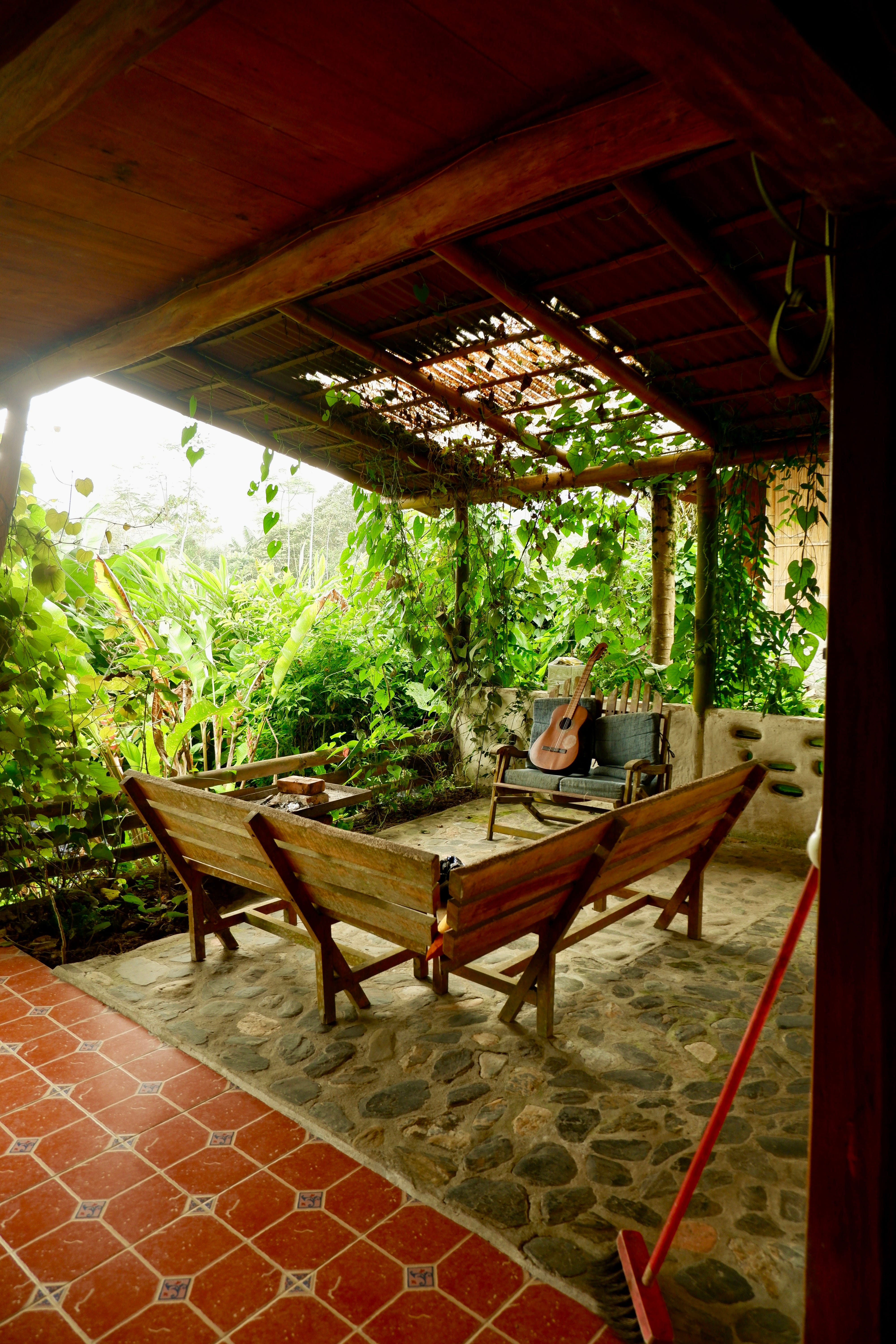
But the real charm of that night came after the steambath, when we all hung out in Bruno’s home. I’m hesitant to call it a “house” because that usually conjures an image of doors and walls, which — like my housing at Mashpi Shungo — weren’t really present. You take your shoes off by a welcome mat, pass through a little swinging gate, and enter a warmly lit space decorated with artisanal rugs and dulled couches — the kind with that deep, broken-in comfort only decades of good use can create. While we lounged barefoot and passed around fresh fruit, frogs croaked and fireflies flickered in the trees. Someone strummed a guitar, and at one point, the kids put on an impromptu ballet performance. It was one of those perfect moments that you can’t get on video — in fact the thought never even crossed my mind — and there was nothing flashy about its perfection. It was just simple, heart-filling, and human.
At the end of the day, that’s what I’m going to remember about Mashpi: the feeling of being human and more fully alive. I’ve often wondered what life would be like if it were stripped of arbitrary distractions and dehumanizing systems — well, this was it. It was one of the most humbling and grounding experiences of my life and pushed me to redefine my life priorities. Most importantly, it reminded me that being human can be freaking awesome — especially when you fill your life with things that feel good, like community, nature, and pure, childlike joy (and, of course, good chocolate).
Just to be clear, I’m not moving to Mashpi. Yes it’s beautiful and yes I was sentimental to leave, but I’m taking what I’ve learned from this rare experience and trying to use it to build a better life for my future self. I’ve got to keep moving: there’s so much more to see, more to do, and many more blog posts to write! The journey ahead is long and this is just the tip of the iceberg. Thanks for coming along.
What a revelation to feel safe, connected to each other and nature. That is what life should feel like! And for the record, we only denied soccer until the 5th grade and are fully aware that we “ruined” your potential soccer career! To be fair, we weren’t stoked about sitting in the rain 🤷♀️😂
Damn ethan! You make me question my life every time I check into this Substack. And you left the mamacita note on a cliff hanger…truly incredible this journey you’re on. The catch up culture, lack of community is continued to be felt here in Santa Monica. Love to keep living vicariously through these stories. Hope to join you on the next adventure